AI Face Swap vs. Deepfake: What Is the Difference?
AI face swap is a narrow creative tool; a deepfake is a category of synthetic media. Here is where the two overlap, where they differ, and what the law says.
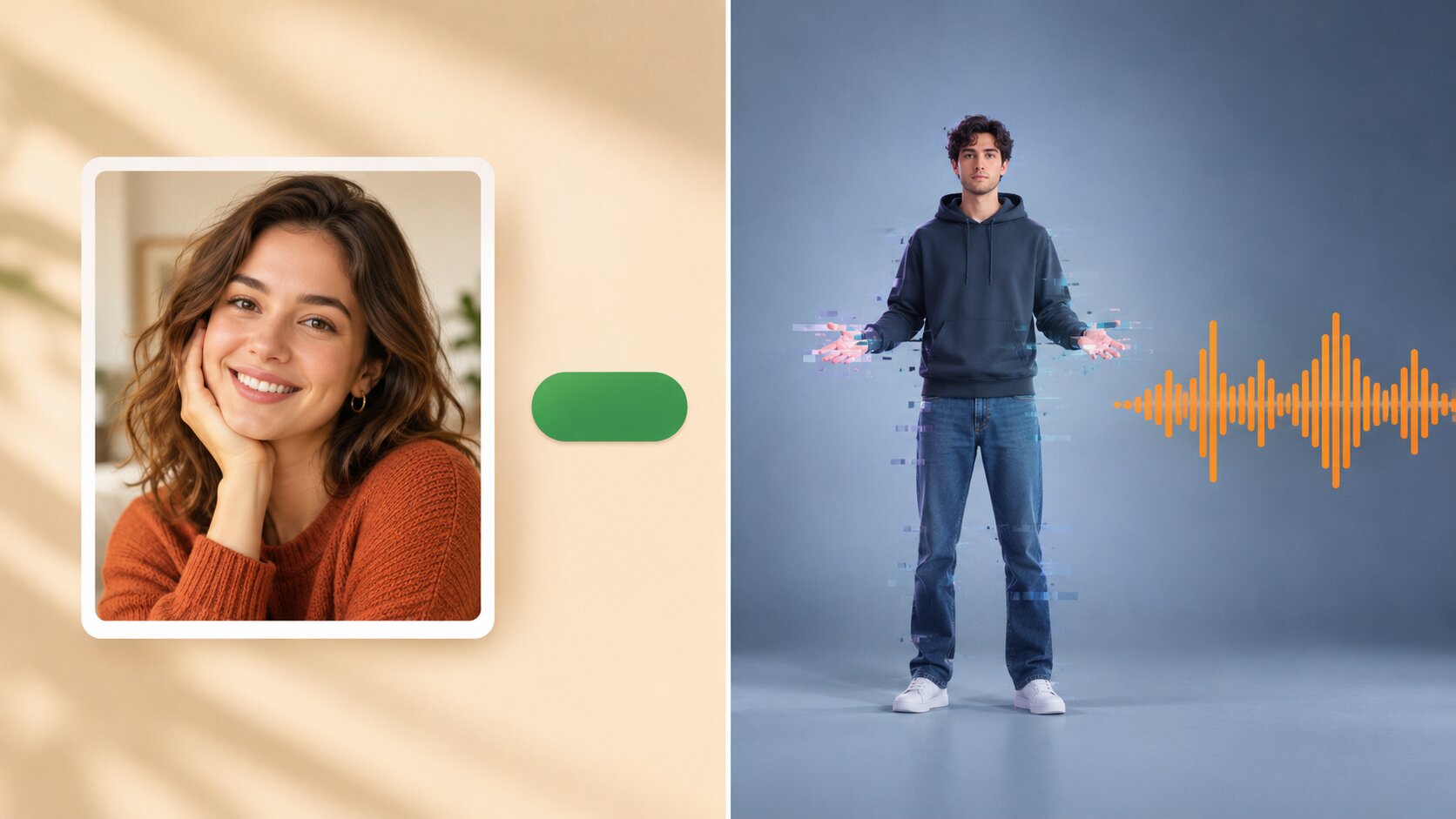
AI face swap and deepfakes use overlapping technology, but they are not the same thing. Face swap is a technique — moving one face onto another photo. A deepfake is a category of synthetic media built to look like real footage of a real person, and it may combine face replacement, voice cloning, body generation and lip-sync. The technique is the tool; the deepfake is the intent behind it.
That distinction decides where the legal and ethical lines actually fall, so it is worth getting precise about before using Try it freeAI Face SwapSwap faces between two photos with realistic results. or any similar tool.
AI Face Swap vs. Deepfake: The Comparison
| Dimension | AI face swap | Deepfake |
|---|---|---|
| What it is | A technique for placing one face into another photo | A category of synthetic media that impersonates a real person |
| Typical output | A single still image | Video, audio, or a full synthetic scene |
| Scope | Face region only — the rest of the photo is untouched | Often the whole frame, sometimes a whole synthetic person |
| Intent | Usually creative, satirical, or exploratory | Deception is the point |
| Typical use | Memes, film pre-visualisation, character design, ad localisation | Fraud, fake endorsements, non-consensual imagery, political disinformation |
| Technical complexity | Low — two photos, one click | High — face tracking, temporal smoothing, voice cloning, lip-sync |
| Time and cost | Seconds, a couple of credits | Minutes to hours, orders of magnitude more expensive |
| Detection difficulty | Moderate | High, and rising every year |
| Legal exposure | Low when used on consenting or self-sourced images | High, and often criminal |
| Content moderation | Basic — identity and prohibited-content checks | Strict — provenance logs, liveness checks, active takedown processes |
The overlap is real
A deepfake video of a person saying something they never said almost certainly uses the same face-replacement model that a meme generator uses. The model does not know or care what it is being used for. When the tool is the same, the difference between a creative edit and a deepfake is entirely in the intent, the context and the disclosure.
The practical dividing line
Ask two questions:
Does the image deceive someone about something that matters? A photo of a friend with a cartoon face on a birthday card does not. A video of a company CEO apparently announcing a merger does.
Would the person in the image want this to exist? Consent from the person whose face is used is the strongest signal of legitimacy. Most reputable tools make this the basis of their terms.
If both answers are comfortable, you are working with face swap. If either answer is uncomfortable, you are in deepfake territory, and the fact that a free tool made it easy is not a defence.
How Deepfakes Are Actually Made
The current generation of deepfakes is a stack rather than a single model:
- Face detection and tracking. A tracker finds the face in every frame and keeps it registered as the head moves.
- Face replacement. An identity-preserving model regenerates the face each frame, matching the new expression and head angle.
- Temporal smoothing. Because each frame is generated slightly differently, a smoothing pass enforces consistency across neighbouring frames. Without it the face swims and flickers.
- Voice cloning. A separate model reproduces the target's voice from a short sample, matching cadence and intonation.
- Lip sync. The mouth is re-shaped to match the new audio.
- Body and scene generation. For full-body synthesis, a video diffusion model generates the whole frame rather than just the face.
Each stage is individually well understood. The sophistication comes from chaining them and from the sheer volume of training data now available.
How to Spot a Deepfake
Physical inspection is losing its reliability year by year, so treat it as one signal among several rather than a test.
Physical tells — warped or unstable backgrounds, skin that is too smooth or too waxy, an odd ear or asymmetry, lighting that disagrees with the scene, a face that does not move with the head, and irregular blinking.
Behavioural tells — the head turns but the face lags behind it, the mouth shape does not quite match the audio, the skin texture flickers between frames.
Context tells — the request is unusual, the channel changes mid-conversation, someone asks you to move to another platform, urgency about money or credentials, and a story that is plausible but slightly off.
Provenance — C2PA Content Credentials and similar markers are attached to media by cameras, platforms and model providers. Where they are present and intact, they are strong evidence. Where they have been stripped, treat their absence as weak rather than conclusive evidence.
The Legal Picture
Face swapping itself is legal in most jurisdictions. The liability comes from how the result is used.
| Use | Legal position in most places |
|---|---|
| Your own face, or a friend's with permission | Fine |
| Parody, satire, comedy, obvious memes | Usually protected, but commercial use can be restricted |
| Film and television effects work | Fine, under standard production contracts |
| Fake endorsement or testimonial | Unlawful in many places — FTC action in the US, and equivalent rules elsewhere |
| Non-consensual intimate imagery | Illegal in a growing number of jurisdictions, including many that did not previously address it |
| Impersonating someone to obtain money or credentials | Fraud, and often identity theft as well |
| Election or public-office content | Increasingly subject to specific disclosure or prohibition rules |
The pattern across jurisdictions: the technology is not the problem, the harm is. So the practical rule that survives every legal regime is consent plus disclosure.
Which One Should You Use?
- For creative face work — memes, casting pre-visualisation, character design, ad localisation: Try it freeAI Face SwapSwap faces between two photos with realistic results..
- For creating a face from nothing to use as a source: Try it freeAI Face GeneratorGenerate realistic AI faces for any creative use..
- For re-imagining an entire photo rather than just the face: Try it freeAI Image EditorTransform a single photo with a text prompt — restyle, re-light, re-imagine..
- For video work: dedicated video tools with lip-sync and temporal smoothing — a still-photo swap does not survive frame-to-frame.
The Bottom Line
Face swap is a legitimate creative tool with legitimate uses, and the same models that power harmless memes also power serious fraud. The dividing line is consent and context, not the software. Use tools that keep identity verification and content logs, keep your own face out of deceptive content, and label synthetic media where it could be mistaken for real — that single habit does more to keep you out of trouble than any technical measure.
Frequently Asked Questions
Is AI face swap the same as a deepfake?
Not quite. AI face swap is a technique — moving one face onto another photo. A deepfake is synthetic media designed to look like real footage of a real person, usually made with face swap, voice cloning, or both. Every deepfake involves synthetic faces, but most face swaps are creative edits rather than deepfakes, because nothing about them is intended to deceive.
Is face swapping illegal?
The act of swapping a face is not illegal in itself. It becomes unlawful when it is used to defraud, to impersonate someone without consent, to create non-consensual intimate imagery, or to interfere with an election. Most jurisdictions also have disclosure rules for synthetic media in advertising and journalism.
Can AI face swap be used for fraud?
Yes, and that is the reason regulation focuses on it. A convincing swapped face on a video call, paired with a cloned voice, can be used to impersonate someone to their bank, their employer or their family. That is why most tools keep identity verification and content logs, and why banks have started asking for liveness checks.
How do I tell if an image or video is a deepfake?
Look for physical tells first: warped backgrounds, odd skin texture, asymmetry in the ears, a face that does not track head movement, inconsistent lighting on the face versus the scene, and strange blinking patterns. Then look for context tells: the wrong story, an unusual request for money or credentials, and requests to move to a different channel. Modern generations defeat most physical checks, which is why context matters more than ever.
Do deepfakes have a watermark?
Most do now. Metadata watermarks from C2PA and similar standards are embedded at capture time by cameras and platforms, and model providers add invisible markers to their own output. These are helpful but not foolproof — they can be stripped by a screenshot and a crop, so they are evidence rather than proof.
What is the difference between a face swap and a face morph?
A face swap takes one identity and puts it into another scene. A morph blends two faces into a new identity that belongs to neither person, such as combining a parent and a child. The same underlying models handle both; the prompt and the blend weights decide which one you get.
Can face swap be used for good?
Yes. Film and television have used face replacement for decades to double actors across age, to stunt-double, and to re-age characters. Medical visualisation, video localisation, and accessibility tooling all use the same technology for clearly beneficial purposes.
Should I worry about face swaps of myself?
Practically, yes — deepfake pornography and impersonation scams are the fastest-growing misuse. Keep your social media photos public only if you are comfortable with that risk, and search your own name periodically on the platforms where misuse is most common.
Want a workflow question answered? Get in touch — we read every message.
Try these tools
Try it freeAI Face SwapSwap faces between two photos with realistic results.Try it freeAI Image EditorTransform a single photo with a text prompt — restyle, re-light, re-imagine.Try it freeAI Face GeneratorGenerate realistic AI faces for any creative use.Try it freeAI Professional HeadshotsGenerate studio-quality headshots from a single selfie.Sources
- U.S. Federal Trade Commission — AI-generated content and impersonation fraud — Reference for how impersonation scams are constructed and the disclosure expectations around synthetic media.
- MIT Media Lab — DeepFake detection research — Reference for the physical and behavioural tells that distinguish synthetic faces from real ones.
- C2PA — Content Credentials specification — Reference for the provenance and watermark standards used to mark synthetic and edited media.
- InsightFace — Open-source face analysis toolkit — Reference for the face detection, alignment and recognition technology shared by both creative tools and deepfake pipelines.