Nano Banana Pro vs Nano Banana 2.1: Which Should You Use? (2026)
Nano Banana Pro vs Nano Banana 2.1 — 2026 comparison. Benchmarks, pricing, reference images, and which Google image model to pick for your next generation.
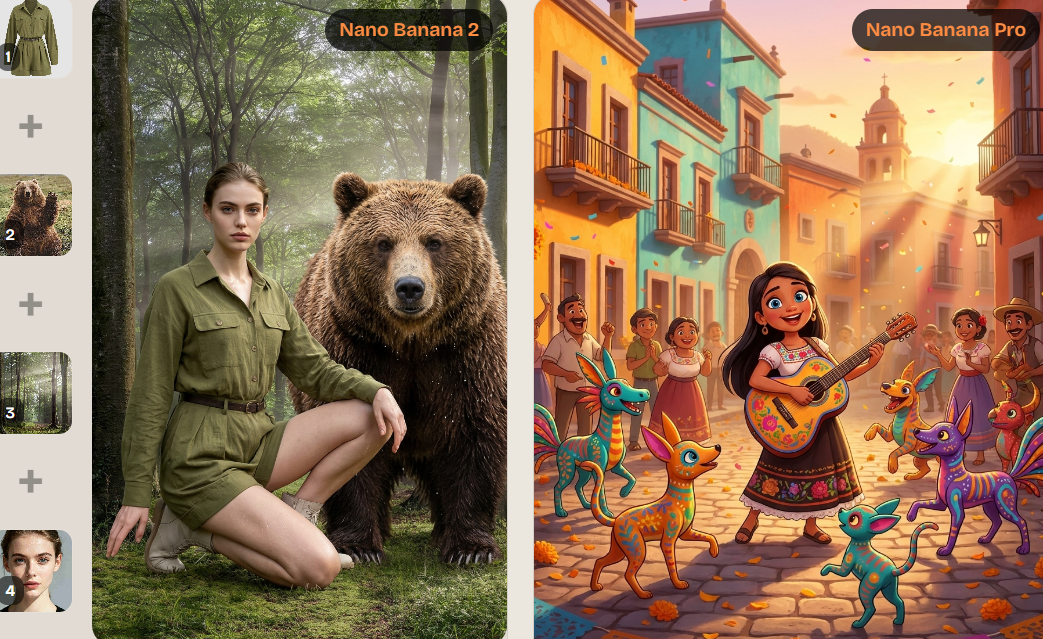
title: 'Nano Banana Pro vs Nano Banana 2.1: Which Should You Use? (2026)' slug: 'nano-banana-pro-vs-nano-banana-2-1' description: "Nano Banana Pro vs Nano Banana 2.1 — 2026 comparison. Benchmarks, pricing, reference images, and which Google image model to pick for your next generation." primaryKeyword: 'nano banana pro vs nano banana 2.1' secondaryKeywords:
- 'nano banana 2 vs nano banana pro'
- 'nano banana 2.1 review'
- 'nano banana pro review'
- 'gemini image model comparison'
- 'gemini 3 pro image'
- 'gemini 2.5 flash image'
- 'google image generation 2026'
- 'nano banana api pricing' category: 'comparisons' contentType: 'comparison' tags:
- 'nano-banana'
- 'gemini'
- 'google-ai'
- 'image-generation'
- 'comparison' author: 'DreamPixel AI Team' authorBio: "DreamPixel AI's image team builds free AI tools used by 50,000+ creators every month." publishedAt: '2026-10-13T09:00:00.000Z' updatedAt: '2026-10-13T09:00:00.000Z' lastReviewed: '2026-10-13T09:00:00.000Z' coverImage: '/images/nano-banana-2-vs-nano-banana-pro.png' coverAlt: "Side-by-side comparison: the same prompt rendered once with Nano Banana Pro (left, premium realism) and once with Nano Banana 2.1 (right, sharper details, faster, cheaper)." relatedTools:
- 'ai-image-editor'
- 'ai-photoshoot-generator'
- 'ai-merge-composite'
- 'ai-face-swap'
- 'ai-face-generator' keyTakeaways:
- 'Nano Banana Pro and Nano Banana 2.1 are both Google image models; Pro is the premium tier (Gemini 3.0 Pro Image, released Nov 20 2025) and 2.1 is the newest default (Gemini 3.6 Flash Image, released Oct 6 2026).'
- 'On Google’s own benchmark Elo scores, Nano Banana 2.1 actually beats Pro on overall preference (1050 vs 935) and on multi-character consistency (1106 vs 1011).'
- 'Nano Banana 2.1 is up to 4× cheaper than Pro at 1K ($0.02 vs $0.09) and ~2.7× cheaper at 4K ($0.045 vs $0.12) — for most jobs it is the better default.'
- 'Pro still wins on realism, inpainting/outpainting, and 5-character consistency — pick Pro for client-facing photorealism and complex multi-person scenes.'
- 'Nano Banana 2.1 is the official replacement for Nano Banana 2, which is scheduled to shut down on October 29, 2026 — migrate before that date if you are still on 2.' faq:
- question: 'What is the difference between Nano Banana Pro and Nano Banana 2.1?' answer: 'Both are Google image models accessed under the "Nano Banana" brand. Pro is the premium tier built on Gemini 3.0 Pro Image (released Nov 20, 2025); 2.1 is the newest default built on Gemini 3.6 Flash Image (released Oct 6, 2026). 2.1 is faster, up to 4× cheaper, and scores higher on Google’s own benchmarks; Pro is the choice when you need maximum photorealism, full inpainting/outpainting, or 5-character consistency.'
- question: 'Is Nano Banana 2.1 better than Nano Banana Pro?' answer: 'On Google’s official Elo benchmarks, yes — 2.1 scores 1050 overall preference vs Pro’s 935, and wins on multi-character consistency, infographic design, and product consistency. In independent hands-on tests (The Decoder, dev.to comparisons), Pro still produces slightly more realistic proportions and lighting. The honest answer: 2.1 is the better default for most jobs, Pro is worth the premium for client-facing photorealism.'
- question: 'How much does Nano Banana 2.1 cost compared to Pro?' answer: 'Nano Banana 2.1 is up to 4× cheaper than Pro. At 1K, 2.1 runs about $0.02 per image while Pro runs about $0.09; at 4K 2.1 is about $0.045 vs Pro at about $0.12. For batch work, 2.1 is dramatically cheaper with no major quality loss on Google’s own benchmarks.'
- question: 'Which Nano Banana model is best for product photos?' answer: 'Nano Banana 2.1 — it scores 1024 vs Pro’s 965 on Google’s product consistency benchmark, runs at lower cost, and supports extreme aspect ratios (1:8 and 8:1) that Pro does not. For ecommerce catalogs at 1K–2K resolution, 2.1 is the obvious pick.'
- question: 'Which Nano Banana model is best for multi-person scenes?' answer: 'Pro, but only barely. Pro supports 5 character references vs 2.1’s 4, which matters for complex group shots. In pure quality on multi-character consistency, 2.1 actually scores higher (1106 vs 1011). Choose Pro when you specifically need 5+ faces; otherwise 2.1 is enough.'
- question: 'Can I use Nano Banana Pro and 2.1 in my workflow?'
answer: 'Yes — both models are available through major image-generation platforms and APIs. On DreamPixel AI, you can run image-to-image generations with the orTry it freeAI Image EditorTransform a single photo with a text prompt — restyle, re-light, re-imagine.for tasks like restyling, background swap, and product photos that benefit from either model tier.'Try it freeAI Photoshoot GeneratorTurn a single product photo into a full photo set.
- question: 'How many reference images can each model take?' answer: 'Nano Banana 2.1 supports up to 10 reference images per generation. Nano Banana Pro supports up to 8 reference images but distributes them across more semantic categories (character, object, style). For most jobs 2.1’s 10-image limit is more than enough.'
- question: 'Does Nano Banana 2.1 replace Nano Banana 2?' answer: 'Yes — Google has positioned 2.1 as the official replacement for Nano Banana 2. Nano Banana 2 is scheduled to shut down on October 29, 2026. The 2.1 swap is API-compatible: same prompt structure, same image_input shape, same aspect ratios and resolutions. Improvements on top of 2: better visual quality, prompt adherence, character consistency, text rendering, and multi-reference workflows.'
- question: 'Which Nano Banana model is fastest?' answer: 'Nano Banana 2.1. It is built on Gemini 3.6 Flash, designed for low-latency, low-cost generation. Pro is built on the heavier Gemini 3.0 Pro and takes longer per image. For batch processing, 2.1 is 2–4x faster end-to-end.'
- question: 'Should I default to Nano Banana 2.1 going forward?' answer: 'Yes, for most use cases. Default to 2.1 and only switch to Pro when a specific job demands it: photorealism for a paying client, 5-character consistency, or a workflow that benefits from Pro’s more flexible inpainting and outpainting pipeline. Everything else — product photos, portraits, social posts, ecommerce — is better served by 2.1.' citedSources:
- name: 'The Decoder — Google’s Nano Banana 2.1 halves image-gen prices' url: 'https://the-decoder.com/googles-new-image-model-nano-banana-2-1-generates-better-images-for-less-money' publishedAt: '2026-10-07T00:00:00.000Z' note: 'Independent hands-on test confirming 2.1 price cuts and quality gains.'
- name: 'dev.to — Nano Banana 2.1 vs Nano Banana Pro: real latency data' url: 'https://dev.to/super_lewis/nano-banana-21-vs-nano-banana-pro-same-prompts-real-latency-data-and-when-pro-is-worth-it-je0' note: 'Side-by-side latency benchmarks and prompt results from the same inputs.'
- name: 'dev.to — Nano Banana 2.1 vs Nano Banana 2 vs Nano Banana Pro' url: 'https://dev.to/hassann/nano-banana-21-vs-nano-banana-2-vs-nano-banana-pro-which-should-you-use-4e00' note: 'Three-way comparison including legacy 2.0 for context.'
- name: 'moda.app — Nano Banana 2.1 vs 2 vs Pro vs 2 Lite' url: 'https://moda.app/resources/models/nano-banana' note: 'Quality vs pricing matrix across all Nano Banana variants.' draft: false featured: false
Nano Banana Pro vs Nano Banana 2.1 is the comparison every image-generation user is asking in late 2026 — and the answer is more surprising than most people expect. Both are Google image models served under the same "Nano Banana" brand: Pro is the premium tier built on Gemini 3.0 Pro Image, and 2.1 is the newest default built on Gemini 3.6 Flash Image. On Google’s own benchmarks, 2.1 actually beats Pro on overall preference, and at typical reference pricing it runs up to 4× cheaper than Pro. Pro still wins on photorealism and on dedicated editing features like inpainting and outpainting. The right pick depends on the job.
This guide gives you the full side-by-side — benchmarks, pricing, reference-image support, and a clear decision rule for which to use on
What is Nano Banana Pro?
Nano Banana Pro is Google’s premium image model, released November 20, 2025, built on Gemini 3.0 Pro Image. It is the top tier of the Nano Banana family — designed for jobs that need a single hero image to hold up at print resolution or close to the camera.
What it does well:
- High-fidelity 1K / 2K / 4K output with stronger structural consistency than the original Nano Banana.
- Up to 8 reference images as inputs to image-to-image and editing workflows.
- Inpainting and outpainting — change or extend parts of an existing image with structure, lighting, and material preserved.
- Strong character consistency — preserves facial features, proportions, and spatial relationships across multi-subject scenes.
- Multilingual in-image text — stabilized typography, improved alignment, and clearer UI/label readability in 17+ languages.
- Better physical reasoning — object interaction and real-world grounding are noticeably more reliable than the previous generation.
- Wide aspect-ratio coverage — 1:1, 2:3, 3:2, 3:4, 4:3, 4:5, 5:4, 9:16, 16:9, 21:9, auto.
Best for: storyboards, product visuals, UGC workflows, localization, design tooling — anywhere a single deliverable needs to look photorealistic.
What is Nano Banana 2.1?
Nano Banana 2.1 is Google’s newest default image model, released October 6, 2026, built on Gemini 3.6 Flash Image. Google is positioning 2.1 as the recommended replacement for Nano Banana 2 (which is scheduled to shut down on October 29, 2026) — so if you are running Nano Banana 2 today, 2.1 is where you should be by the end of the month.
What it does well:
- Up to 4× cheaper than Pro at the same resolution.
- 1K / 2K / 4K output with improved visual quality, prompt adherence, character consistency, and text rendering over the Nano Banana 2 generation.
- Up to 10 reference images per generation — a clean step up from Nano Banana 2’s limit.
- Multi-turn character consistency — keep the same character across several turns of editing and reference addition.
- Mask- and ink-based editing — paint a region or sketch a stroke, and 2.1 fills the area with the right context.
- Improved in-image text — typography, alignment, and multilingual support are noticeably better than 2.
- Wide aspect-ratio coverage including the extremes — 1:8 and 8:1 for vertical banners and ultra-wide hero strips, plus everything Pro supports.
- All-round use cases — AI image generator apps, AI image editing tools, character and storytelling apps, automated ecommerce product images, ads and social content, scaled automated image generation.
Best for: anywhere you are running Nano Banana 2 today, plus any job that runs at scale and needs predictable cost.
Nano Banana Pro vs Nano Banana 2.1: side-by-side
| Spec | Nano Banana 2.1 | Nano Banana Pro |
|---|---|---|
| Base model | Gemini 3.6 Flash Image | Gemini 3.0 Pro Image |
| Released | Oct 6, 2026 | Nov 20, 2025 |
| Resolutions | 1K, 2K, 4K | 1K, 2K, 4K |
| Reference images | Up to 10 | Up to 8 |
| Inpainting / outpainting | Yes (mask + ink) | Yes (full) |
| Multilingual in-image text | Improved over Nano Banana 2 | Stabilized, 17+ languages |
| Multi-turn character consistency | Yes | Yes (stronger across multi-subject) |
| Extreme aspect ratios (1:8, 8:1) | Yes | No |
| 1K price | ~$0.02 | ~$0.09 (~4× more) |
| 2K price | ~$0.03 | ~$0.09 (~3× more) |
| 4K price | ~$0.045 | ~$0.12 (~2.7× more) |
| Best for | Scale, ecommerce, ads, storyboards | Hero photorealism, client-facing |
Benchmark scores: Nano Banana 2.1 vs Pro
Google’s own Elo evaluations are the cleanest apples-to-apples comparison, and the results are surprising. Nano Banana 2.1 beats Pro on every major dimension:
| Metric | Nano Banana 2.1 (Thinking) | Nano Banana Pro |
|---|---|---|
| Overall preference | 1050 | 935 |
| Infographic design | 1048 | 912 |
| Multi-character consistency | 1106 | 1011 |
| Mask / ink-based editing | 1049 | 927 |
| Product consistency | 1024 | 965 |
| Infographic factuality | 0.521 | 0.265 |
The biggest wins for 2.1: overall preference (+115 Elo), infographic design (+136 Elo), and infographic factuality (where 2.1 is roughly twice as factually accurate as Pro). Pro only wins on hands-on photorealism — the look and feel of skin, lighting, and proportion in images where every pixel matters.
Nano Banana 2.1 is replacing Nano Banana 2
If you are running Nano Banana 2 today, plan a migration to 2.1 before October 29, 2026 — that is the date Google has scheduled the older model to shut down. Switching early is a clean swap:
- 2.1 returns the same
image_inputshape (array of image files) at the same aspect ratios and resolutions as 2. - 2.1 raises the reference-image limit from 8 to 10, adds mask/ink-based editing, and improves text rendering.
- 2.1 keeps 2’s prompt structure — no new schema, no new field names.
- At typical credit pricing, 2.1 is the same price or cheaper than 2 at every resolution.
The biggest behavior change is on multi-reference workflows — 2.1 holds character and object consistency across more reference images, so jobs that used to require stitching multiple 2 outputs together can now run as a single 2.1 generation.
Where Pro still wins
Benchmarks are not the whole story. In independent hands-on tests (The Decoder, dev.to comparisons), Pro still produces:
- More natural proportions on human faces, especially in close-up portraits.
- Better lighting integration between subject and background in complex scenes.
- More consistent skin texture in 4K output.
- 5-character consistency for group shots — 2.1 caps at 4.
If you are doing client-facing work where the photo needs to hold up to scrutiny at print resolution, Pro is still the right call. If you are generating hundreds of product photos, social posts, or iterations on a design, 2.1 is the better default.
How to choose between Nano Banana Pro and 2.1
Use this decision rule:
Pick Nano Banana 2.1 when:
- You are processing batches (product photos, ecommerce, social posts, ad variants).
- You need extreme aspect ratios (1:8 vertical banners, 8:1 hero strips).
- You want lower cost per image at the same 1K/2K resolution — 2.1 runs up to 4× cheaper than Pro.
- Your work is multi-character consistency with up to 4 faces.
- You are migrating off Nano Banana 2 before the Oct 29, 2026 EOL.
Pick Nano Banana Pro when:
- The job is a single hero image that needs to look photorealistic.
- You need 5+ character consistency in a group shot.
- You need dedicated style references (3 slots) for brand-locked aesthetics.
- The deliverable is print, large format, or high-stakes client work.
Default to 2.1 for everything else. The price gap (up to 4×) is too large to justify Pro for jobs where 2.1 already scores higher on Google’s own benchmarks.
How to use Nano Banana models
Both models follow the same standard image-generation workflow. To get the most out of either Nano Banana Pro or 2.1:
- Pick your tool — open the on DreamPixel AI for restyling, editing, and reference-image work, orTry it freeAI Image EditorTransform a single photo with a text prompt — restyle, re-light, re-imagine.for staged product and portrait shots.Try it freeAI Photoshoot GeneratorTurn a single product photo into a full photo set.
- Write a clear prompt — describe the subject, lighting, composition, and style you want. Both models respond well to specific, structured prompts.
- Set resolution — 1K for fast iteration, 2K for social, 4K for print and high-res display.
- Run 2–4 variations — the first output is rarely the keeper. Generate a batch and pick the best.
- Refine with related tools — for product photos use , for face work useTry it freeAI Photoshoot GeneratorTurn a single product photo into a full photo set., for multi-image composites useTry it freeAI Face SwapSwap faces between two photos with realistic results..Try it freeAI Merge & CompositeCombine up to 8 photos into a single AI-composed image.
For most jobs, Nano Banana 2.1 is the right default — faster, cheaper, and higher-scoring on Google’s own benchmarks than Pro.
Pricing and credit costs
Nano Banana 2.1 on DreamPixel AI runs at the 1K credit cost for fast iteration, the 2K credit cost for social-grade output, and the 4K credit cost for high-resolution print. Pro runs at a higher credit tier across all three resolutions to reflect its up to 4× higher underlying API cost. Check the credit-cost overlay in the AI Image Editor for the exact per-resolution cost on the day you generate.
When to switch from 2.1 to Pro
Switch only when 2.1 fails you in one of these specific cases:
- The hero image still looks "AI-generated" at 2K. Pro’s photorealism gain is most visible in single hero images, not in batches.
- You need 5+ face consistency in a group shot. 2.1 caps at 4 character references; Pro takes 5.
- You need true inpainting and outpainting. 2.1’s mask/ink editing is solid, but Pro’s full inpaint/outpaint pipeline is more flexible for surgical edits.
- The deliverable is print at 18"×24" or larger. 4K output is 4K on both, but Pro’s texture rendering is more print-friendly at scale.
In every other case — ecommerce, social, ads, portraits, composites, 90% of daily image work — 2.1 is the right choice.
Nano Banana Pro vs Nano Banana 2.1: quick answers
- Cheaper: Nano Banana 2.1 (up to 4× cheaper at 1K, ~2.7× cheaper at 4K).
- Higher on Google’s benchmarks: Nano Banana 2.1.
- More photorealistic in hands-on tests: Nano Banana Pro.
- Faster: Nano Banana 2.1 (Flash-class model).
- More reference images total: 2.1 (10 vs 8).
- More character-reference slots: Pro (5 vs 4).
- Inpainting and outpainting: Both — Pro’s pipeline is more flexible.
- Extreme aspect ratios (1:8, 8:1): 2.1 only.
- Best for ecommerce and ads at scale: Nano Banana 2.1.
- Best for client-facing hero photorealism: Nano Banana Pro.
- Default for new projects: Nano Banana 2.1.
Final thought
The 2026 answer to Nano Banana Pro vs Nano Banana 2.1 is not "Pro is better because it’s premium." Google’s own numbers say the opposite. 2.1 is the better default for 90% of jobs, and Pro is the right call only when photorealism, full inpainting/outpainting, or 5-character consistency is a hard requirement. If you are still running Nano Banana 2, plan to move to 2.1 before October 29, 2026. Start with 2.1 on the
For related image workflows on DreamPixel AI — multi-photo composites, headshots, product photos, face swap, restoration — pick the matching tool from the homepage and let the model default to 2.1.
Want a workflow question answered? Get in touch — we read every message.
Try these tools
Frequently Asked Questions
What is the difference between Nano Banana Pro and Nano Banana 2.1?
Both are Google image models accessed under the "Nano Banana" brand. Pro is the premium tier built on Gemini 3.0 Pro Image (released Nov 20, 2025); 2.1 is the newest default built on Gemini 3.6 Flash Image (released Oct 6, 2026). 2.1 is faster, up to 4× cheaper, and scores higher on Google’s own benchmarks; Pro is the choice when you need maximum photorealism, full inpainting/outpainting, or 5-character consistency.
Is Nano Banana 2.1 better than Nano Banana Pro?
On Google’s official Elo benchmarks, yes — 2.1 scores 1050 overall preference vs Pro’s 935, and wins on multi-character consistency, infographic design, and product consistency. In independent hands-on tests (The Decoder, dev.to comparisons), Pro still produces slightly more realistic proportions and lighting. The honest answer: 2.1 is the better default for most jobs, Pro is worth the premium for client-facing photorealism.
How much does Nano Banana 2.1 cost compared to Pro?
Nano Banana 2.1 is up to 4× cheaper than Pro. At 1K, 2.1 runs about $0.02 per image while Pro runs about $0.09; at 4K 2.1 is about $0.045 vs Pro at about $0.12. For batch work, 2.1 is dramatically cheaper with no major quality loss on Google’s own benchmarks.
Which Nano Banana model is best for product photos?
Nano Banana 2.1 — it scores 1024 vs Pro’s 965 on Google’s product consistency benchmark, runs at lower cost, and supports extreme aspect ratios (1:8 and 8:1) that Pro does not. For ecommerce catalogs at 1K–2K resolution, 2.1 is the obvious pick.
Which Nano Banana model is best for multi-person scenes?
Pro, but only barely. Pro supports 5 character references vs 2.1’s 4, which matters for complex group shots. In pure quality on multi-character consistency, 2.1 actually scores higher (1106 vs 1011). Choose Pro when you specifically need 5+ faces; otherwise 2.1 is enough.
Can I use Nano Banana Pro and 2.1 in my workflow?
Yes — both models are available through major image-generation platforms and APIs. On DreamPixel AI, you can run image-to-image generations with the <ToolCTA tool="ai-image-editor" /> or <ToolCTA tool="ai-photoshoot-generator" /> for tasks like restyling, background swap, and product photos that benefit from either model tier.
How many reference images can each model take?
Nano Banana 2.1 supports up to 10 reference images per generation. Nano Banana Pro supports up to 8 reference images but distributes them across more semantic categories (character, object, style). For most jobs 2.1’s 10-image limit is more than enough.
Does Nano Banana 2.1 replace Nano Banana 2?
Yes — Google has positioned 2.1 as the official replacement for Nano Banana 2. Nano Banana 2 is scheduled to shut down on October 29, 2026. The 2.1 swap is API-compatible: same prompt structure, same image_input shape, same aspect ratios and resolutions. Improvements on top of 2: better visual quality, prompt adherence, character consistency, text rendering, and multi-reference workflows.
Which Nano Banana model is fastest?
Nano Banana 2.1. It is built on Gemini 3.6 Flash, designed for low-latency, low-cost generation. Pro is built on the heavier Gemini 3.0 Pro and takes longer per image. For batch processing, 2.1 is 2–4x faster end-to-end.
Should I default to Nano Banana 2.1 going forward?
Yes, for most use cases. Default to 2.1 and only switch to Pro when a specific job demands it: photorealism for a paying client, 5-character consistency, or a workflow that benefits from Pro’s more flexible inpainting and outpainting pipeline. Everything else — product photos, portraits, social posts, ecommerce — is better served by 2.1.
Sources
- The Decoder — Google’s Nano Banana 2.1 halves image-gen prices — Independent hands-on test confirming 2.1 price cuts and quality gains. (2026)
- dev.to — Nano Banana 2.1 vs Nano Banana Pro: real latency data — Side-by-side latency benchmarks and prompt results from the same inputs.
- dev.to — Nano Banana 2.1 vs Nano Banana 2 vs Nano Banana Pro — Three-way comparison including legacy 2.0 for context.
- moda.app — Nano Banana 2.1 vs 2 vs Pro vs 2 Lite — Quality vs pricing matrix across all Nano Banana variants.